Penalty Kick: The Psychology Behind Football’s Most Intense Duel
A penalty kick is a great tension moment in football. One goal can be the difference of a whole season, or a player’s stature can be changed forever. The reason it is the most intense kind of microcosm of a football game is the source of its simplicity: one shooter, one “keeper”, and all the people watching. In that brief period, success depends on a lot of things other than just skill. Actually nerve, memory, body language, and decision-making are up to a point activated before ball strike.
Fine points are often what tipping points become. Analysts dissect run-up trajectories, favorite shooting spots, overall patterns, while coaches often use video sessions, not unlike a grammar checker polishing a sentence, to remove errors from the smallest habits and sharpen decision-making under stress. For top-notch performers, a penalty is not a bet but a standard sequence which can be performed time and time again. Routine → many times done under pressure → clear mind.
In fact, thinking a penalty as being a mere chance is forming an incorrect picture of reality.
Trending articles: Football rules ✅ Soccer regulations & Laws of the Game by FIFA, FA, IFAB
Contenidos
Penalty Kick: Analyzing the Psychological Aspects
Both physically and mentally, the one who is to shoot the ball is facing the challenging situation. How -to-keep-silent-one’s-body even though the tension-level has increased is a rather difficult task to accomplish for a kicker. Before the time comes, they are already almost entirely emotional, which means that they got a lot of changes inside of them. Cardiovascular level becomes above the norm, breathing is shortened, and there is a possibility of getting stuck in the middle of the action.
In this regard, pre-actions are highly valuable. According to sports psychology, sticking to a routine can be a great way for athletes to keep their concentration since it provides them with a kind of mental script to go by. Therefore, quite a few top-level scorers settle on their target even before the referee blows the whistle, then they get into a breathing rhythm, and finally perform the same sequence of their actions every single time.
One’s way of doing this with different. For example, Jorginho was one of those players who made use of a stutter-step to provoke the goalkeeper into making a move prematurely. On the other hand, players like Robert Lewandowski put more trust in timing and disguise. Regardless of the technique, the main idea is still the same: less hesitation is a result of more consistency.
The role of accuracy is also underlined by statistics which show that a well-placed shot close to the corners is a lot more difficult for the goalkeeper to save than a really powerful but totally uncontrolled shooting. The kicker’s biggest problem, the one that really comes before the goalkeeper, is their own hesitation. Usually, the deciding factor is how well someone can make up their mind about a certain thing and go through with it.
The Goalkeeper’s Game: Reading and Disrupting Penalty Kicks
Saving a penalty from the perspective of the goalkeepers is a quite demanding combination of processes involving anticipation, analysis, and the effect of psychological pressure. Really, there is almost no room for making a mistake. If you make the move too early, the kicker can still change their mind and do something else. If you hesitate for too long, the ball will have passed you already.
Top-level goalkeepers use the ability to decipher very subtle clues. Such clues can be their opponent’s body form, how the feet are placed, a minor indication in posture, and so on. These indicators are there and gone in the blink of an eye which makes it even more necessary to be well-prepared. Also, watching videos of previous shots and other forms of data analysis help a lot in spotting various patterns such as the direction they prefer shooting at and their style of running up to the ball.
Meanwhile, many goalkeepers actively attempt to throw off the kicker. They use different delaying tactics to keep the ball out of play, point the corners, or confuse the kicker with movement and presence. Emiliano Martínez, for instance, gained fame as a goalkeeper who employed psychological tactics in shootouts. The aim is straightforward: to make the kicker look at the goalkeeper and not at the goal.
According to studies, in these cases, expecting or anticipating what the opponent will do matters more than the time to react.
The ball moves too fast for the goalkeepers’ reflexes to be the determining factor, so they often commit themselves based on what they expect will happen and not what they actually see. From this viewpoint, a penalty kick is simply a physical struggle, but it is also an exchange of information.
Pressure and Repetition: Training for the Moment
Pressure does have a very tangible impact on performance. You may see a player who always scores in training get very nervous in a game situation with the stakes so high. He could be doing his run-up differently because he is in a hurry, or maybe he just freezes. Also, without him knowing, there might be very slight changes in his technique.
This is the reason why nowadays, in addition to monotonous practice, training activities are blended with pressure elements like crowd noise, time limits and consequences. The main intention behind these measures is to get players used to stress, so when it is really their time, they feel like they have done it before and will therefore not be overwhelmed.
Confidence is a double-edged sword as well. It may be that after a missed penalty kick a player changes his way of doing it completely, even though being consistent would have been his best option. Conversely, a goalkeeper who only by saving one penalty psychologically affects the next takers, can gain the upper hand. Thus the penalty, apart from the technical side, the mental one is just as important which is the key to recovery after a mistake.
In a typical penalty shot, about three-quarters or four-fifths of them are converted, i.e. scored. However, one missed penalty kick can undo a player’s good work on the pitch throughout the game. This is why such a small segment of the game is receiving so much attention.
Technique Under Pressure: Precision Over Power in a Penalty Kick
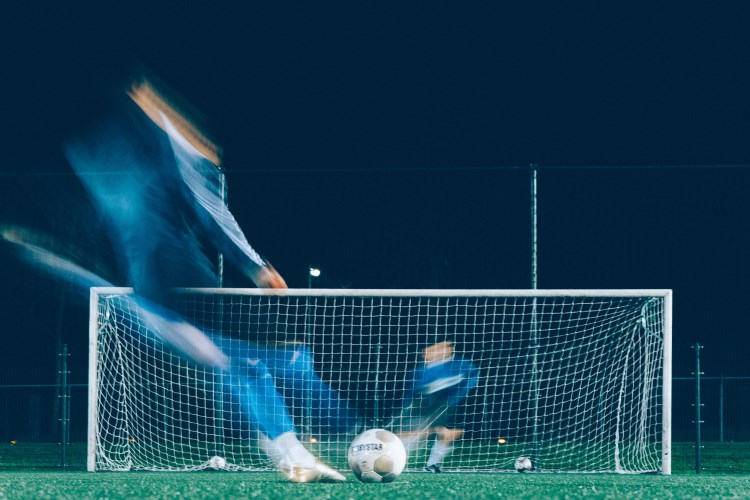
From a spectator’s viewpoint, scoring a penalty kick might look like child’s play, but the reality is that even the smallest mistake in the technical execution can completely ruin it. The positioning of the supporting foot, the alignment of the body, and the time and place of touching the ball will all help to determine what will happen. Tiny blunders could easily result in the ball being off-target.
It is generally accepted that the best shots are those aimed low and accurately, as they give the keeper very little time to react. That is why a well-placed low ball usually sneaks past the keeper. High shots look great, but they run the most risk. Simply, the space for error is much smaller.
Besides that, there is an element of game strategy as well. Some players move in the direction they want the ball to go according to the goalkeeper’s movement, others make the decision early and rely on their skill to do the trick. A few deviate from the norm and try something risky, like the Panenka. Andrea Pirlo’s legendary volley from the spot during Euro 2012 has been etched in the memory because the three elements of perfect timing, extraordinary composure, and perfect execution were all in one. Nevertheless, each attempt that succeeds is set against dozens that do not, for such is the nature of the gamble.
A Battle Before the Ball Is Struck
At the most fundamental level, the penalty kick is nothing but a mind game played even before the shot is taken. The shooter is in search of a sure thing, but the keeper wants to plant the seed of uncertainty. Both sides are able to sway each other through various means such as body language, timing, and overall presence.
Excellent penalty takers are capable of doing much more than just hitting the ball properly; actually, they handle the entire situation, including things like their breathing, facial expressions, and even their decision-making. Similarly, the best goalkeepers mix preparation with gut feelings and thus manage to transform their basically reactive part into something more active.
That’s the reason why the penalty kick is regarded as a big deal. It’s not simply one move, but rather it is the essence of a testing of limits, a duel of thorough readiness and self-control, all of which gets presented to the world in a matter of seconds.
Trending articles: How to organise a Football tournament 🏆 Proposal, Budget, Sponsorship