
Secret Techniques from FIFA Games That Improve Football Knowledge
Ask almost every football enthusiast where they first caught the phrase high press, false nine, or inverted full-back, and it’s very likely that it was not from a coaching course. Probably, it was from a football video game. For a long time, FIFA and, later, EA Sports FC, have not been just amusement. They provoke players to try different moves, to match different formations, and to see the motions that elude even the keenest viewer. In trying to win games on their consoles, many fans unknowingly gain a better football knowledge.
That doesn’t point to the fact that a video game can substitute a good coach or professional years of training. It obviously can’t. But the game can open people’s eyes to the sport of football in a novel way. They stop seeing twenty-two players running after a ball and start observing the patterns: the sudden change in space by one team, a press that results in errors, or why swapping one player in the middle can have a massive impact on the whole system.
The higher your focus on such aspects, the more you start enjoying football. And this is the greatest learning moment of all.
Trending articles: Football rules ✅ Soccer regulations & Laws of the Game by FIFA, FA, IFAB
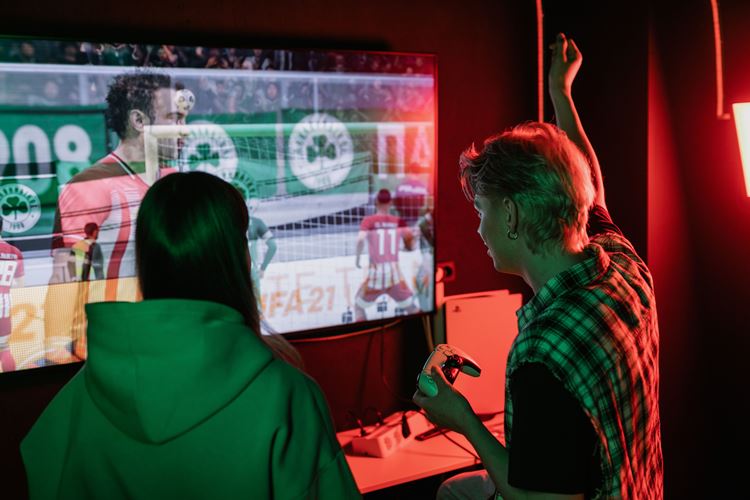
The role of FIFA Games in boosting Football Knowledge
One of the major misunderstandings about video games in general and football ones in particular is the idea that they are only about physical skills. However, anyone who has had some experience playing can attest to the fact that this is not the case.
Of course, quickness is important, but often it is tactical choices and the player’s understanding that set the good players apart from the novices. Being able to choose the best time to press, to take a moment to breathe and change the flow rather than forcing a pass, or to see when a full-back has left the space behind him are often what count more than a fast hand.
It’s, to a very large extent, quite similar to football.
Top coaches dedicate several hours to working with footballers on how to anticipate scenarios. Computer games are far from being able to depict such detailed training, yet they do offer the players the opportunity of repeatedly facing the game scenarios. And after quite a number of matches, certain patterns will start feeling quite familiar.
You’ll start to get a sense when your team is mixing up their midfield. You’ll soon find out why playing centrally through the middle is not always the most effective route. Before long, you’ll even be able to foresee counterattacks way before they happen. And counterattack strength supports live betting, over goals, next goal, and World Cup Betting analysis when a team repeatedly breaks into open space.
One of the biggest perks maybe that errors do not lead to serious consequences. Drop the ball, reset the stage and have another go. Such liberty fuels daring, and hesitation along with it is the path where actual football comprehension develops.
Football Knowledge Through Formations and Player Roles
Primarily, one looks at a formation because the favourite club was using it. Step by step, they get to understand its real purpose and function and thus enrich they football knowledge.
After all, changing a 4-3-3 into a 3-5-2 does not mean just relocating players on a small tactics board. Changes happen to wing-backs having much more space to cover, central defenders getting different passing options, and midfield either gaining or losing numerical superiority depending on the opponent.
Such differences are noticeable because you actually feel them while they are happening.
The same applies to individual roles. A holding midfielder is not simply the guy standing in the centre circle. On many occasions, he is the link between defence and attack, the first option in passing after regaining the ball and the one in charge of covering the space when other players go forward.
Wide forwards present yet another example. Keep them close to the line and they force the defence to stretch. Get them to the inside and they open intervals for the overlapping full-backs. Both ways have their pros and cons.
Having figured these concepts out, it is a great pleasure to see the football game. Your sole attention towards the ball will be shifted to noticing all the things happening around it as well. And connecting real match data and the history of the FIFA World Cup with formations and momentum seen in the FIFA Game can help you learn a lot about football.
Understanding Space and Transitions
Players may chase the ball, but it is the space that ultimately makes or breaks the game.
This is yet another football saying that makes sense until you actually witness the game. Thanks to football video games, it is a lesson that is easier to understand because every good scoring move involves the attacker getting to a space where there wasn’t any a moment before.
At times, it’s a winger drawing a defender far from the main zone. Other times it is a midfielder who runs and no one follows. The ball is given after that. The space comes before the ball.
Transitions are the key to understanding the significance of those moments.
When a team wins the ball, the pitch feels huge. When they lose it, naturally, everything feels smaller. A team that reacts fast is often the one to score the best chances because opponents have no time to reorganize.
After watching numerous games, you don’t only look at the player with the ball. Your eyes start moving to the players that run, passing lanes, and open spaces that can be used.
This habit grows even more watching live football. Instead of a series of isolated actions, a televised football match starts resembling a continuous battle for gaining ground. You start understanding why there are some teams that are so comfortable playing through pressing while other teams appear to be stuck. They do not improve individually. Usually, it is because they grasp the concept of space a split second ahead of others.
How FIFA Builds Football Knowledge Through Tactical Awareness
Players reach a level where the no longer simply respond to the current events on screen but also anticipate what is going to take place. This is probably the greatest tactical teaching that a football game can deliver.
Let us take defending a counterattack as an example. Newbies generally start chasing the ball right away. More proficient ones will often disregard the ball holder for a moment and instead close the passing lane. Though not as thrilling, it is more effective most of the time.
This is the type of forward thinking that can’t be acquired immediately. It is a result of the fact that the same scenarios keep getting repeated. Players start noticing familiar sequences even before they complete.
The very same idea holds true when offense is concerned. Besides passing to the player who is free at that particular moment, the top players pass to the spot where that player will be a second later. This small difference totally changes the pace of an attack.
Games simultaneously encourage patience. Forcing a forward play every time is a recipe for losing the ball. The practice of recycling, waiting for the movement of the defense and carrying out the attack when the time is right usually yield the best results. Even professional football operates on this principle.
Gradually, these routines create football knowledge. Players begin understanding defensive formations, noticing the moments that a team’s pressing is triggered and become aware of the situation when a team is intentionally inviting pressure rather than making mistakes. The gamers’ minds continue working after the match as these information get naturally transferred into football watching on television.
From Gaming Lessons to Real Football
The revelation that footballers have begun witnessing things ignored to them before is a delightful experience for them. Rather than tracking only the player with the ball, one’s gaze will be on the left-back’s positioning. The steady glance over the shoulder of a defensive midfielder just before he receives the ball will become clear. The wide splits by centre-backs to initiate attacks and how wingers raise their positions to stretch the opponents will be recognized.
Although football simulations do not teach these ideas explicitly, they are motivating players to notice them. Consider a straightforward sequence of attacks. The goalkeeper passes to a centre-back. Then, the defensive midfielder fills the gap between the two defenders. The full-backs advance and, while one attacking midfielder moves between the opposition’s midfield and defence, the other stays in touch with the ball to help facilitate the play.
On the surface, things may look quite ordinary.
Undoing each movement for the details may be a great help. The gist of it is that in one way or another, each of them is either trying to make a pass available or create space for the one who will receive it. When you have seen game patterns being regularly repeated, it becomes a lot easier to spot most of them during a real game.
That is the reason why so many think football strategy is really not all that complicated when they can relate to a football game. Heat maps, passing work and positional diagrams become not so abstract as one is already somewhere familiar with those concepts in the top-notch simulation football game.
Used in this manner, football matches turn from a mere pursuit of virtual trophies to a tool that helps the player learn to analyze the game more deeply.
Understanding Football Through Games Has its Limitations
Real football is full of variables which cannot be completely captured by any kind of simulation. Different players’ ways of getting tired are only one example. Furthermore, a team’s confidence level after a goal against them can either go up or down. To this list one can add weather, crowd atmosphere and individual personalities, all of which lead to various choices which a mere single player with a controller is incapable of mimicking.
Videogames reward players only for such actions that logically fit into the system of that game. If we turn to real life football, we will see that very often it is almost neglect the probability part deciding the correctness of a decision. For example, for a football player, the pass that is risky and forward with the ball may be a perfect one at the moment while if the next moment passes without any one in the team that possession becomes out of the team then the pass is a disaster.
Games often get wrong tactical formations as unchangeable entities. For instance, A 4-3-3 formation might become 3-2-5 in possession in one breath and a compact 4-5-1 without the ball, the very next moment. Such fluid transitions are extremely difficult to encompass, let alone understand them.
If a person is serious about football, the best is to access the knowledge of the sport through multiple channels. Video games that simulate football can serve to pique one’s interest and thereby have one’s tactical concepts strengthened. However, on top of that, watching actual games, getting insight from coaches, reading about tactics and, playing football themselves will put the finishing touches on the layers that no video game could ever entirely replicate.
Trending articles: How to Organise an eSports Tournament: Onsite, Online PC & Video Gaming